Description of DMS
In gas the speed of ions in electric field can be estimated with following formula:
where α(E/N) represents field depencency called α-function and E/N is relation
between field and number density expressed in Townsends.
α-function can be approximated as
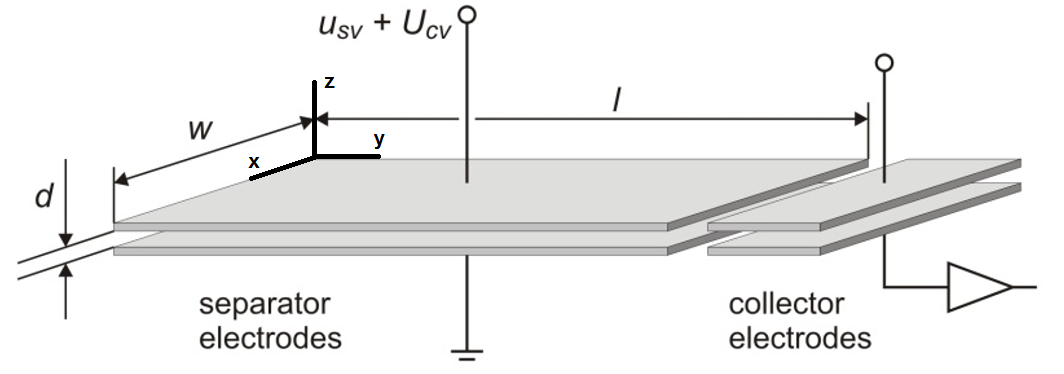
DMS aka Differential Mobility Sensor consists filter and detector. The filter is built from two electrodes separated with a narrow gap. Gas flows between the electrodes and carries ions thorough the filter area. The filter is followed by detector plates which collect ions that survive in the filter.
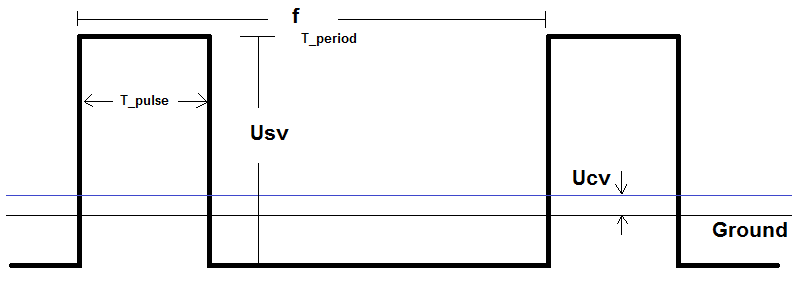
To use electrodes as a filter an asymmetric waveform is added between the DMS electrodes.
The asymmetric waveform has high and low field sections. During the high field
the ions move fast with field depending mobility and during low part with constant k.
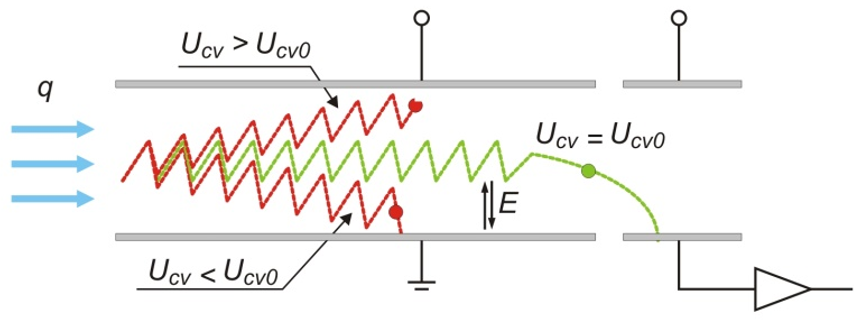
Ions oscillate between the plates and if the movement is asymmetric, the ions enter to
electrons and neutralize. However, if another DC field created by Ucv is applied
some ions with zero net oscillation can survive and will be carried via filter
and can be measured as a signal IDMS:
Monte Carlo simulator
DMS Monte Carlo simulator simulates the movement of ions in DMS filter with physics based formula including a random movement caused by diffusion. The movement of ions is simulated with following formulas:
The movement of ion is simulated until z coordinate exceeds cell height or is less than zero or y coordinate is longer than cell width.
Realization of the MC simulator
Simulator is written with javascript. Simulator uses web worker-technique and actual MC simulator runs in background not hooking the user interface when running. The graphs have been built with chart.js.
Simulator works with the following kind of logic:
ion : {z,y,alive:true|false}
ionCount : {ucv,survived}
for each Ucv
return ionCount
Waveform
Waveform is defined by duty cycle, frequency and Usv. The waveform is generated to have zero integral. The waveform is updated if any parameter is changed.
Simulation time, Time step Δt and other things
Simulation time depends on how long ions survive in the DMS channel.
Simulation time gets longer if ions survive well. Flow, geometry, field and
mobility parameters have impact to survivability and thus to simulation time.
Time step Δt should be around 0.1% of pulse period for sensible results.
Too short Δt may produce inaccurate results. However, short Δt
means long simulation time. ΔUCV has impact to simulation time too.
Saving results
Simulation results are saved in JSON format to the file provided in "Result file" input field.
Saving and reading DMS parameters
DMS parameters are saved in JSON format to the file provided in "Parameter file" input field. The values of data can be edited with text editor. However, the structure must not be changed.
Known issues, comments and ideas